| In
order to obtain good quality dry leaves one must take into
consideration the factors that may affect the quality of
the product and the availability of the following minimum
necessary elements:
I- Drying Element
1.
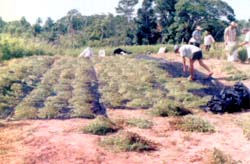
70% half shade mesh
One must have available a half mesh shade of 20 to 25 metres
with a wooden stick or bamboo at each end in order to ease
its handling.
2.
Cleaning Tent
One should have a tent of at least 3 x 3 metres in which
to separate the leaves, the stalks and black leaves as well
as for the final drying.
3.
Leaf Bags
The dry leaves must be placed in sacks and kept in dry and
well-aired sheds.
II- Facts to be considered
1.
Dew
Cutting must be done after the evaporation of the dew.
2.
Time of cutting
Cutting must be undertaken only in the morning hours - up
to 10 or 11 a.m. This will allow, in the best of cases,
in completing the drying out in the same day.
3.
Volume of cuttings
The amount of cut branches must not be greater than the
disposability of drying meshes.
One must not pile up the branches higher than 10 centimetres
in thickness. As we are using numerous varieties at the
same time, their maturing will not be even and one may do
the cutting by selecting the plants about to flower, which
will allow for more cuts thus easing the drying and manipulation
of the leaves.
4.
The Sun Heat
This is very good for the drying process, but one must learn
to use it. In the days of excessive heat the cut branches
must be laid out for airing which is accomplished in approximately
two (2) hours or less exposition. Then they are taken to
the shade and later can again be put out to dry in the sun.
5.
Rain - Showers
The cut branches must not be exposed to rain or showers
as this will cause immediate oxidisation of the leaves.
6.
Clear Nights
The cut branches must not be left out during the night because
dew and clear skies will oxidise the leaves.
7.
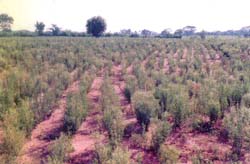
Ideal time for cutting
The ideal time for cutting is when the first flower buttons
make an appearance because that shows when the plant has
finished its development, the leaves are mature and it is
also the moment for the highest crystal content (Stevioside).
Complying
with these recommendations will allow the farmer to obtain
high quality dry leaves with a good market price since the
product for human consumption is presented in natural form.
The
average production of dry leaves per year without risks
is that of 1.500 kilos per hectare. With irrigation systems
one can obtain per year between 3.000 and 5.000 kilos per
hectare.
|